
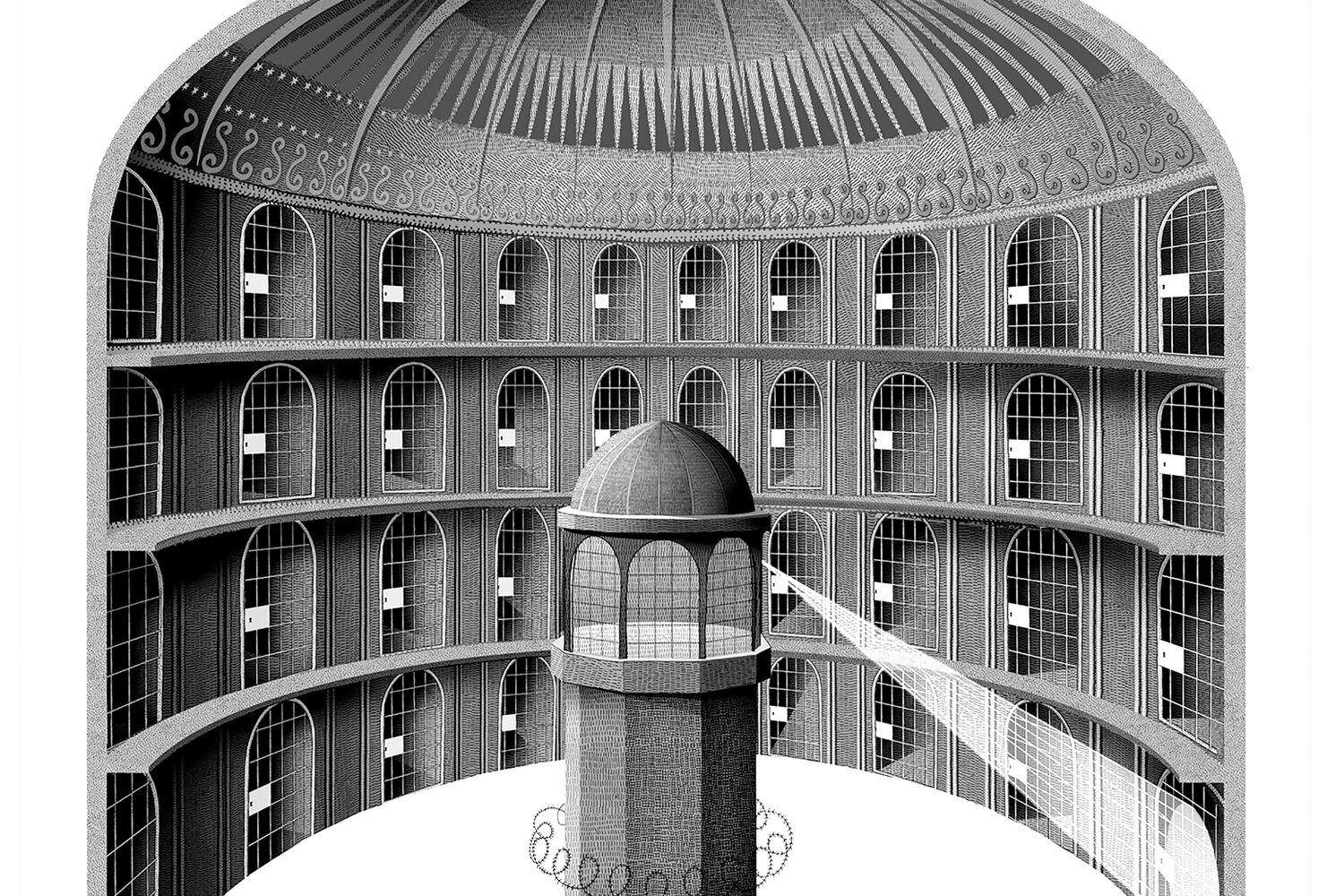
In this paper, the author researches a panoptic carceral state of the XXI century, whose functions are reduced to maximum social control through the wide use of imprisonment and quasi-imprisonment practices and the spread of non-institutional forms of restriction of freedom (including non-punitive ones).
The methodology of the research is based on works of Rusche, Kirchheimer, Melossi, Pavarini, Foucault, Cohen, Bauman, Albrecht and other scholars. Proposing the ideas of ‘quasi-deviant’, ‘the carceral state’ and ‘penological pessimism’, the author analyses the priority of ‘protection of the society from deviants’ in public policies in the XXI century, simulacraisation of measures of ‘protection of the society’ and lowering the threshold of deviance.
The aims of the research are to analyse: 1) the nature of contemporary penal practices; 2) the justification of punishment; 3) how social control spreads in the XXI century; 4) how the boundaries between imprisonment and non-institutional applications of imprisonment as well as between punishments and non-punitive forms of social control blur; 5) how the tension between ‘freedom’ and ‘security’ develop.
The research covers such issues as 1) clarification of the content of the terms ‘prison policy’ and ‘social control’ in the XXI century; 2) political and economic nature of new trends in social control policies and practices; 3) global consequences on crime prevention, sentencing and prison policies; 4) probable scenarios for the evolution of social control policies in the global and national dimensions; 5) the concept of a quasi-deviant as a special new collective object of social control; 6) penological pessimism as a fundamental characteristic of social control policy and practices; 7) growing supranational nature of modern prison policy; 8) institutional violence in the XXI century.

 Dmytro Yagunov